
How to read a headstone in the Old Jewish Cemetery
The carvings are not decoration. They are surnames, professions and priestly lineage, in stone.
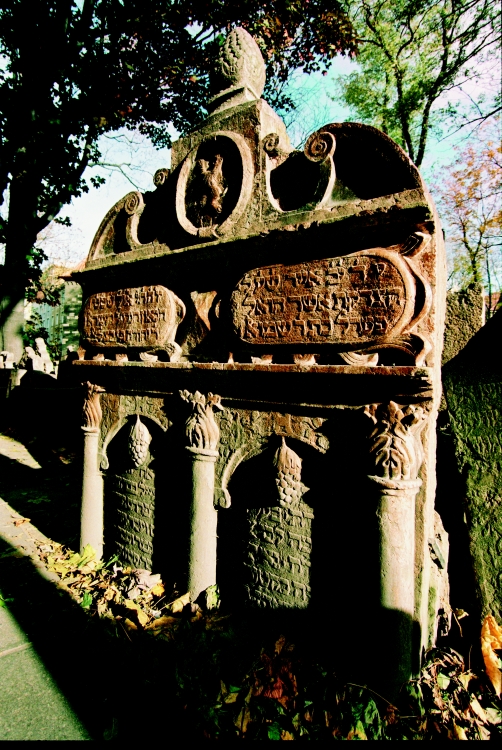
Visitors photograph the cemetery as a mood: leaning stones, dappled light, the famous crowding. Fair enough — it photographs beautifully. But the stones are also a database, and once you can read three or four symbols you stop seeing a mass grave and start seeing individuals with jobs, families and, in a fair number of cases, a sense of humour.
Two hands, fingers split
The priestly blessing. This is a kohen, a descendant of the priestly line, and the hands are the ones raised over the congregation at the duchening. If you have ever seen the Vulcan salute, this is where Leonard Nimoy got it — he watched it from behind his father's tallit in a Boston shul.
A jug or a basin
A Levite. Levites washed the hands of the kohanim before the blessing, so the jug marks the family that served. Kohen and Levi stones are the easiest identification in the whole cemetery and they turn up constantly.
Animals, because names were literal
- Lion — Yehuda, Leib, Löw. The tribe of Judah and the Yiddish name for lion collapsed into one symbol.
- Deer or stag — Zvi, Hirsch. Same logic in another language.
- Bear — Dov, Ber.
- Wolf — Ze'ev, Wolf. Benjamin, too, from Jacob's blessing.
- Fish — Ephraim, or sometimes a hint at fertility and blessing.
- Goose or bird — the Gans family, whose most famous member is buried here: David Gans, astronomer, historian, correspondent of Kepler and Tycho Brahe.
Grapes, scissors, a mortar and pestle
Grapes are usually a blessing motif, sometimes a wine trade. Scissors mean a tailor. Mortar and pestle, an apothecary. Tweezers and a small basin, a physician or a barber-surgeon. A book, a scholar or a printer — Prague had a Hebrew press running from 1512, one of the earliest north of the Alps, and printing families show up on these stones.
You are not looking at a cemetery of rabbis. You are looking at a cemetery of a city: doctors, printers, tailors, moneylenders, midwives, and the people who buried them.
The stones people leave
Pebbles on the top of a grave are the Jewish equivalent of flowers — a marker that says someone came. The folded notes wedged into the cracks around Rabbi Löw's tomb are a much later custom, borrowed from the Western Wall, and the burial society has mixed feelings about them because paper and damp destroy sandstone. If you want to leave something, leave a stone.
The four graves worth finding
- Rabbi Judah Loew ben Bezalel, the Maharal, died 1609. The big Renaissance tomb everyone crowds. Talmudist and educational reformer long before he was a Golem story.
- Mordechai Maisel, died 1601, mayor of the Jewish Town and financier to Rudolf II, who paved the quarter's streets out of his own pocket.
- David Gans, died 1613, the astronomer. His stone carries a goose and a star.
- Hendl Bassevi, died 1628, wife of the first Jew ennobled in the Habsburg lands. Hers is the most ornate stone in the cemetery, and it belongs to a woman.
Men cover their heads inside the cemetery; paper kippot are available at the entrance. Stay on the path — the ground between the stones is burial ground, not a shortcut.
Give it forty minutes rather than fifteen. The crowd flows through in one direction and thins out badly around the far wall, near the Klausen Synagogue, which is where the older and stranger stones are.
Questions we get asked
- What do the symbols on Prague's Jewish cemetery headstones mean?
- Hands with split fingers mark a kohen, a jug marks a Levite, and animals stand for names — a lion for Yehuda or Löw, a deer for Zvi or Hirsch, a bear for Dov. Tools such as scissors or a mortar and pestle indicate the person's trade.
- Why are there so many layers of graves in the Old Jewish Cemetery?
- The community was not permitted to buy more land and Jewish law forbids moving the dead, so soil was added and new burials were laid above older ones — up to twelve layers in places, which is why the ground rises in mounds.
- Who is buried in the Old Jewish Cemetery in Prague?
- An estimated 100,000 people, with about 12,000 visible stones. Notable graves include Rabbi Judah Loew (the Maharal), the mayor and financier Mordechai Maisel, the astronomer David Gans and Hendl Bassevi.
Want this walked with you?
Tell us your dates, languages and what you care about. We match you with a licensed Prague guide who actually fits — or we tell you we cannot.