
Why the Spanish Synagogue looks like Granada and has nothing to do with Spain
A reform congregation in 1868 chose Alhambra ornament to say something specific about who they were.
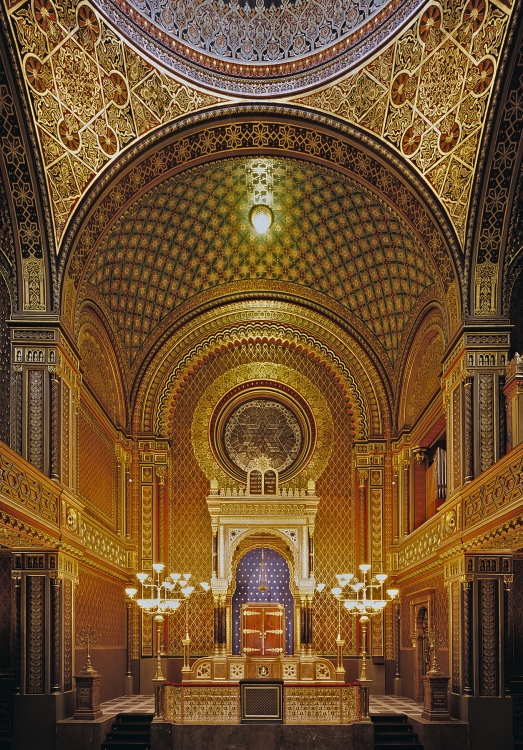
People walk into the Spanish Synagogue and audibly stop. Every surface — walls, gallery fronts, the dome — carries interlaced geometric and floral ornament in gold, red and green, in the style of the Alhambra. It is the most photographed Jewish interior in central Europe and one of the least understood.
It was not built by Sephardim
The congregation was Ashkenazi and reform-minded, worshipping in Czech and German with an organ, which was controversial. The site had held the Altschul, the Old School, the oldest synagogue in the quarter and traditionally associated with a Byzantine rite. When it was demolished and replaced in 1868, the new building took the name Spanish from the older association, not from the people inside it.
Why Moorish Revival, then
Because in the mid-nineteenth century, emancipated Jewish communities across the Habsburg lands and Germany were building large public synagogues for the first time and had to decide what a synagogue should look like. Gothic was the church. Classical was the state. Moorish ornament pointed to al-Andalus — the golden age of Jewish philosophy, poetry and science under Islamic rule — and said: we are an ancient eastern people, we are cultured, and we are not pretending to be Lutherans.
The Alhambra style was an argument about identity, dressed as interior decoration. Vienna's Leopoldstadt temple, Budapest's Dohány Street and Prague's Spanish Synagogue are all making the same case.
What to look at once the shock wears off
- The ornament is not repeated wallpaper. Panels differ; the designers Bělský, Ullmann and Münzberger varied the geometry by zone.
- The organ, added in 1882 — a reform marker that would have been unthinkable in the Old-New Synagogue four hundred metres away.
- The upstairs exhibition on Czech Jewish life from emancipation to the present, which is the museum's strongest and which almost everyone walks past on the way out.
- In the courtyard, Jaroslav Róna's statue of Kafka riding on an empty suit — a nod to a Kafka story, and one of the few pieces of public art in Prague worth stopping for.
The part that is hard to say quickly
The building survived the war because the Nazis stored confiscated Jewish property here — ritual silver, textiles, Torah scrolls taken from communities across Bohemia and Moravia after their members were deported. The museum's extraordinary collection exists because of that. Every guide has to decide how to phrase this, and there is no phrasing that makes it comfortable.
Concerts run here most evenings. The acoustics are good and the room at night, half-lit, is better than the room at noon with forty people photographing the dome.
Questions we get asked
- Why is it called the Spanish Synagogue in Prague?
- The name comes from the earlier synagogue on the site, the Altschul, which was associated with a non-Ashkenazi rite. The 1868 congregation was Ashkenazi and reform; the Moorish Revival style refers to Jewish Spain culturally, not to the worshippers' origins.
- Is the Spanish Synagogue worth visiting?
- It is the most spectacular interior in the Jewish Quarter and holds the Jewish Museum's exhibition on Czech Jewish life since emancipation. Evening concerts are a good way to see the room without the daytime crowds.
- What is Moorish Revival architecture?
- A nineteenth-century style using Islamic-inspired geometric and floral ornament, horseshoe arches and polychrome decoration. European Jewish communities adopted it to evoke the Golden Age of Jewish culture in medieval Spain.
Want this walked with you?
Tell us your dates, languages and what you care about. We match you with a licensed Prague guide who actually fits — or we tell you we cannot.