
The Old-New Synagogue and the trouble with the Golem
A 750-year-old room, a real rabbi, and a monster invented three centuries after he died.
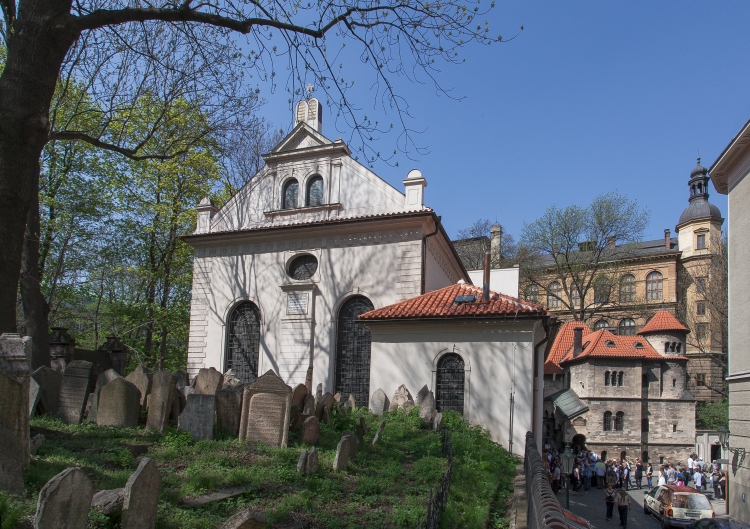
Every guide in Prague tells the Golem story, and every guide in Prague knows it is not from Prague. It attaches itself to the Old-New Synagogue the way legends attach themselves to any building old enough to be strange, and the building would be worth an hour of your time if nobody had ever mentioned clay.
What the building actually is
Built around 1270, early Gothic, and still holding daily services — which makes it the oldest continuously active synagogue in Europe. The hall has two naves separated by two octagonal pillars, an arrangement borrowed from monastic architecture, because the masons who built it were the same Cistercian-trained workshop putting up churches elsewhere in the city.
The vaults have five ribs rather than the standard four. The usual explanation is that a four-rib vault forms a cross, and a synagogue is not the place for one. It may equally be a structural choice. Both explanations are old, and I tell people both.
Why the floor is below the street
You go down steps to enter. Partly Psalm 130 — out of the depths I call to you — and partly because medieval building rules limited how high a synagogue could rise above the surrounding houses, so builders gained height by digging. Then the Vltava flooded, repeatedly, and the streets of Josefov were raised. The synagogue stayed at its original level. It is now sunk in a hole of the city's own making.
Rabbi Löw, the man
Judah Loew ben Bezalel, the Maharal, died in 1609 at a great age. He led communities in Mikulov, Poznań and Prague, wrote extensively on Torah, ethics and pedagogy, argued that children should be taught according to their capacity rather than beaten through a fixed curriculum, and was interested enough in the natural world to be on speaking terms with the astronomers around Rudolf II's court.
That is a substantial life. It contains no monster.
Where the Golem came from
The idea of a man of clay animated by a divine name is old and appears in kabbalistic literature. The specific story of Rabbi Löw building one in Prague to defend the Jews from blood libel accusations first appears in print in the early nineteenth century, and the version everybody knows was popularised by Yudl Rosenberg in 1909 — a Hasidic rabbi in Warsaw who presented his own fiction as a rediscovered manuscript. Three hundred years after the Maharal died.
The Golem is a folk response to fear that was entirely real, invented by people who needed the story. That makes it worth telling. It just does not make it history.
Visiting
- Separate ticket from the Jewish Museum circuit — the Old-New Synagogue is owned by the community, not the museum.
- Closed Saturdays and Jewish holidays. It is a working shul first and a monument second.
- Men cover their heads; kippot are provided at the door.
- Look for the Maharal's chair, kept empty, and the banner given by Ferdinand III in 1648 after the community helped defend the city against the Swedes.
- The attic is closed. There has never been a public route into it, and yes, that is part of why the story survives.
Twenty minutes inside is enough to see it. An hour is what it takes to sit down and let a seven-hundred-year-old room be a room.
Questions we get asked
- Is the Golem of Prague a true story?
- No. The tale of Rabbi Löw creating a Golem first appeared in print in the nineteenth century, roughly 200 to 300 years after his death, and was popularised by Yudl Rosenberg in 1909. The Maharal himself was a real and important scholar, but he left no account of a Golem.
- Why is the Old-New Synagogue below street level?
- It was partly built low because of restrictions on synagogue height and the verse 'out of the depths I call to you', and partly because the surrounding streets were raised over the centuries after repeated flooding of the Vltava.
- Can you visit the Old-New Synagogue?
- Yes, with a ticket separate from the Jewish Museum circuit. It closes on Shabbat and Jewish holidays because it remains an active synagogue with daily services.
Want this walked with you?
Tell us your dates, languages and what you care about. We match you with a licensed Prague guide who actually fits — or we tell you we cannot.