
A thousand years of Jewish Prague in the time it takes to drink a coffee
Privilege, pogrom, golden age, expulsion, emancipation, catastrophe, return. Roughly in that order, several times over.
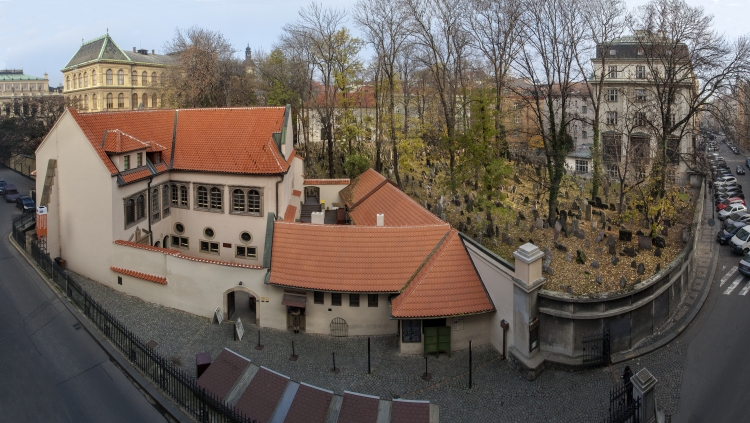
You do not need to memorise dates to enjoy Josefov. But four or five hinge moments make the difference between a nice morning and understanding why a synagogue sits below the pavement, why the cemetery is a hill, and why a community of 50,000 is now a community of a couple of thousand.
965 — the first mention
Ibrahim ibn Yaqub, a Jewish merchant and diplomat from Muslim Spain, describes Prague as a town of stone and lime, the richest trading place in the region. Jews are here from the start of the city's written record, not added later.
1096 — the First Crusade
Crusaders passing through attack the Jewish community. The pattern of the next six centuries appears immediately: protection from the crown when the crown needs money, violence from the street when it does not.
1270 — the Old-New Synagogue
Built in early Gothic style and still in use. That it is standing at all across seven hundred years of fires, floods, expulsions and occupation is the single most improbable fact in Jewish Prague.
1389 — the Easter pogrom
On the last day of Pesach, a mob destroys the quarter and kills most of its inhabitants — estimates around three thousand. The elegy Avinu Malkeinu written afterwards by Avigdor Kara is still read in the Old-New Synagogue on Yom Kippur. His is the oldest surviving stone in the cemetery, from 1439.
1580s–1609 — the golden age
Rudolf II moves his court to Prague and the Jewish Town flourishes: Rabbi Löw teaching, Mordechai Maisel financing and paving, David Gans corresponding with Kepler, a Hebrew printing press exporting across Europe. This period is why the cemetery is full of famous graves.
1744 — expulsion, and return
Maria Theresa expels the Jews of Prague, accusing them of collaborating with the Prussians. Foreign governments and merchants lobby, the economy suffers, and they are allowed back within a few years. The community pays enormous 'tolerance' taxes for the privilege.
1781 and 1850 — emancipation
Joseph II's Edict of Toleration begins the dismantling of restrictions; the quarter is later named Josefov after him. Full civic equality arrives in the mid-nineteenth century, and Jews leave the quarter as soon as they legally can. By the 1890s Josefov is a slum inhabited mostly by the poor, and the city clears it.
1918–1938 — the Czechoslovak years
Masaryk's republic is genuinely good to its Jews: full rights, Jewish nationality recognised on the census, a flourishing German- and Czech-language Jewish literary culture. Prague is one of the best places in Europe to be Jewish. It lasts twenty years.
1939–1945
Roughly 80,000 Jews from Bohemia and Moravia are murdered. Most passed through Terezín. Their names are on the walls of the Pinkas Synagogue. The Nazis concentrated confiscated Jewish property in Prague, which is why the Jewish Museum today holds one of the largest collections of Judaica in the world — objects that survived the people who used them.
1948–1989
Communist rule: emigration, the antisemitic Slánský show trial of 1952, religious life reduced to a supervised minimum, buildings maintained as a museum with no community to fill them.
After 1989
Restitution, restoration, a functioning community of perhaps 1,500 to 2,000 registered members with more unaffiliated, kosher food, a mikvah, Chabad, a school, and services in the Old-New Synagogue on a Friday night that are full of both locals and visitors. Small, and alive.
The Jewish Quarter is often called a museum of a vanished world. Go to the Old-New Synagogue on a Friday evening and you will hear the argument against that from about twenty metres away.
Questions we get asked
- How old is the Jewish community of Prague?
- Jews are recorded in Prague from the tenth century — the merchant Ibrahim ibn Yaqub described the city around 965 — making it one of the oldest continuously documented Jewish communities in Europe.
- How many Jews live in Prague today?
- The registered community numbers roughly 1,500 to 2,000 people, with more Jews in the city unaffiliated. Before the Second World War the community was around ten times that size.
- Why did Prague's Jewish Quarter get demolished?
- After emancipation most Jews moved out and Josefov became overcrowded and impoverished. From 1893 the city cleared it in a sanitation programme, keeping six synagogues, the Jewish Town Hall and the Old Jewish Cemetery and replacing the rest with Art Nouveau streets.
Want this walked with you?
Tell us your dates, languages and what you care about. We match you with a licensed Prague guide who actually fits — or we tell you we cannot.